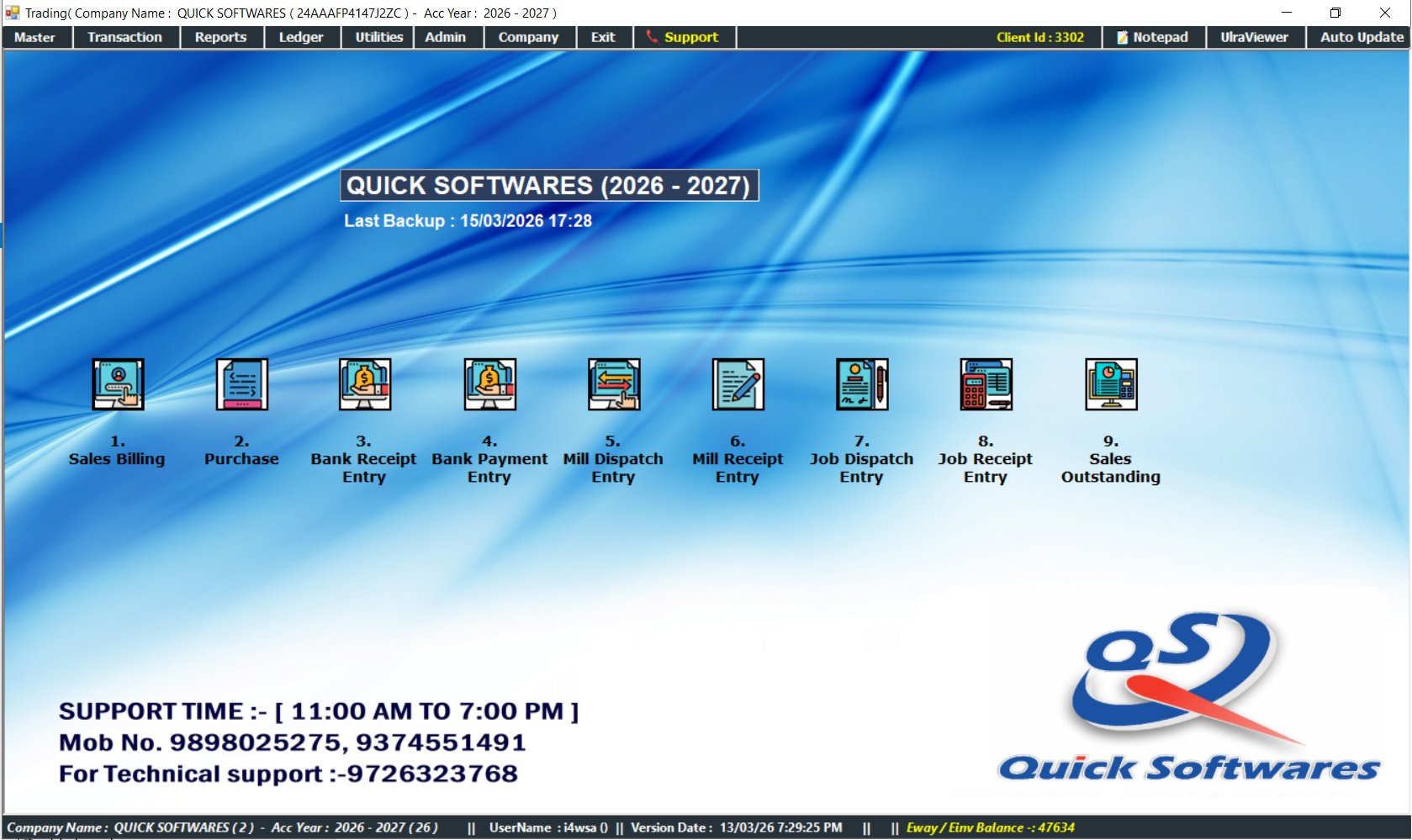
Compliance is often viewed as a burden, but for high-volume textile merchants across the subcontinent, it is a daily reality that must be addressed efficiently. Deploying specialized GST billing software for textile traders is the only way to meet government criteria without slowing down your dispatch teams.
At Quick Software, our tax engine was built from the ground up to understand the specific tax slabs regulating cotton, silk, and man-made filaments in hubs like Surat and Ahmedabad.
Why Basic Billing is No Longer Enough
A standard invoicing tool will merely multiply Quantity x Rate and slap a fixed percentage on the total. In the textile market, one invoice may contain unstitched fabrics at 5% GST and readymade garments above ₹1,000 at 12% GST. Your software must compute these variable item-level taxes accurately and compile them correctly on the printout to be legally compliant.
The E-Way Bill Bottleneck
Waiting for an accountant to manually log into the NIC portal to generate an E-Way bill after creating a physical invoice causes major logistical jams. Our best textile accounting software generates the E-Way bill simultaneously with the invoice using government-approved APIs.
Features of Top-Tier GST Software
1. Automatic HSN Mapping
Every product moving across India requires an HSN code. During inventory setup, our software links the proper HSN to your item groups. At the time of sale, the software applies the right code, preventing fines during transport checks.
2. Dynamic State Code Taxing
When you are a trader in Surat selling to a wholesaler in Delhi, IGST must be applied. If selling locally in Gujarat, CGST/SGST is required. Quick Software reads the destination state code of the buyer and automatically switches the tax ledger structure.
3. Effortless Return Filings
Generating monthly GSTR-1 and GSTR-3B should not take days. Our platform consolidates all your transactions into officially accepted JSON formats. All your accountant has to do is upload the file to the GST portal. See our guide on managing GST for more detailed steps, or explore our Surat-specific accounting solutions.
Never Fear an Audit Again
Achieve 100% tax compliance entirely on autopilot.
Conclusion
Using robust GST billing software for textile traders is about minimizing risk and maximizing dispatch speed. Don't let tax compliance stall your logistics operations. Read more about how our system manages everything from invoices to inventory tracking on our Features page.
Frequently Asked Questions
What makes GST billing software for textiles different?
It accommodates complex multi-tax scenarios across raw yardage and stitched garments, along with delivery challan management which is unique to textiles.
Does the software automatically apply IGST vs SGST?
Yes, by mapping the customer's state code, the software automatically calculates and applies the correct intra or inter-state taxes.
How are E-Way bills generated?
Once an invoice exceeding the mandated value is created, the system uses API integration to generate the E-Way bill instantly without manual entry.
Can I bulk upload data to the GST portal?
Our software generates offline JSON utility files that can be uploaded to the official GST portal with a single click, saving hours of manual data entry.
Does it reconcile GSTR-2B?
Yes, the system helps match your purchase records with the supplier’s filed GSTR-1 (your GSTR-2B) to ensure you claim 100% of your Input Tax Credit.