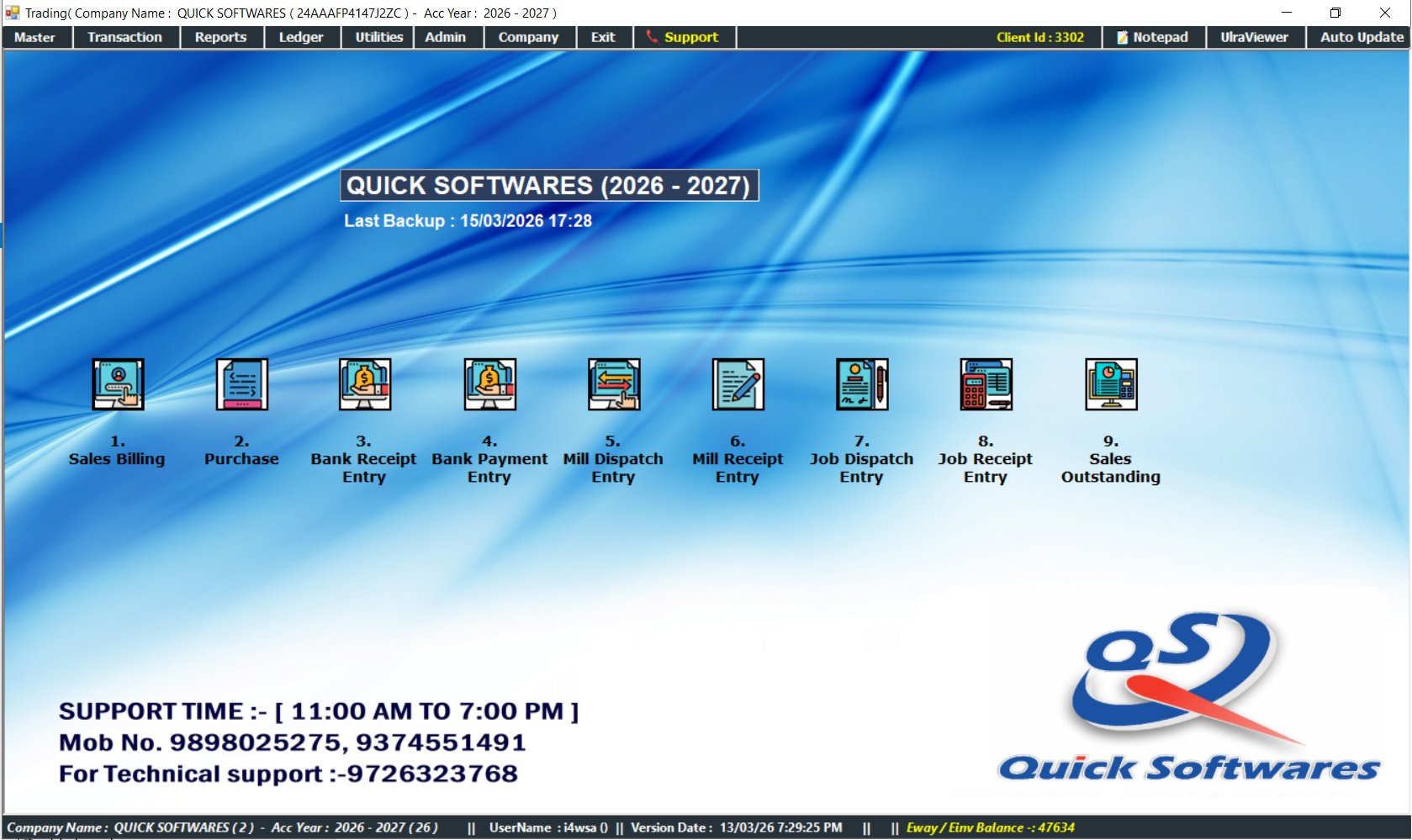
Migrating your trading house or manufacturing unit to a new ERP is a significant investment of time and money. Knowing exactly how to choose the best accounting software for textile business operations is crucial to avoid investing in a platform that forces you to change your workflow.
Quick Software has aided thousands of migrations for textile firms across Surat, Mumbai, and Ahmedabad. Based on that data, we have compiled the definitive factors you must consider before signing any contracts.
Focus on Industry Niche Features
A software designed for a supermarket will fail wildly in a textile shop. Supermarkets sell static items. Textile merchants sell rolls of fabric that shrink, get cut, get dyed, and are brokered. Your first question to any vendor must be: Does this handle job work challans and piece-wise inventory natively?
If the vendor says "we can create a workaround," walk away. The best textile accounting software has these features built directly into its core code.
The Evaluation Checklist
1. The Speed of Billing (Offline capability)
During peak festival seasons, your counters are flooded. Cloud-only tools reliant on browsers slow down and latency creates queues. You need an offline-first desktop architecture that calculates line-items in milliseconds, regardless of your internet connection.
2. Complete GST and Tax Compliance
Ensure the software handles dynamic taxation seamlessly. Refer to our GST Management Guide. Can the software easily export GSTR JSON files? Can it interface with government APIs to generate E-Way bills directly from the invoice screen? If not, you will need a separate accountant just for data entry.
3. Local Support Team
In textile hubs, relationships matter. If your printer stops working or the software hits a glitch, you cannot wait 48 hours for a ticket to be answered by a generic overseas call center. By selecting the best accounting software in Surat or your local region, you guarantee fast, on-ground support. Learn why Surat-based businesses prefer our localized approach.
4. WhatsApp and Mobile Mobility
Can the software send PDF invoices, outstanding ledger reminders, and payment receipts via WhatsApp? Modern businesses utilize WhatsApp structurally. Furthermore, does the software offer a companion mobile application for the owners to check live stock and bank balances while traveling?
Make the Educated Choice
We invite you to evaluate Quick Software against all the criteria listed above.
Conclusion
Knowing how to choose the best accounting software for your textile business boils down to deeply understanding your workflow pain points and selecting the vendor that resolves them natively. Seek vertical-specific platforms, demand offline speeds, and prioritize exceptional local support.
Frequently Asked Questions
How to choose the best accounting software for textile business?
Focus on software that natively supports job-work tracking, piece/taka management, custom brokerage calculations, and robust automated GST features.
Is cloud software better than desktop for textiles?
For Indian textile hubs where internet speed fluctuates, offline-first desktop architectures with cloud-sync capabilities (like Quick Software) perform significantly better at the billing counter.
Why is local support important?
Textile businesses cannot afford downtime. Having a support partner based nearby, such as Surat, ensures rapid resolution of technical issues.
Does the software integrate with WhatsApp?
The best systems provide direct WhatsApp integrations to push PDF invoices and ledger balances directly to clients, enhancing collection speeds.
Is data backup automated?
Top-tier systems offer automated local mirroring and encrypted cloud backups to protect your business against hardware failure.